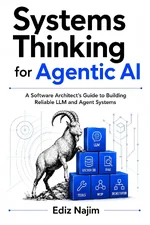
English | May 23, 2026 | ASIN: B0GZSK31J1 | 469 pages | EPUB | 24.57 MB
Build real AI agent systems, not fragile demos.
Systems Thinking for Agentic AI is a practical architecture book for software engineers, backend developers, technical leads, and architects who want to design production-ready applications with large language models.
LLMs are powerful, but an LLM alone is not a system. Real AI applications need prompts, retrieval, tools, memory, and orchestration working together with guardrails, evaluation, observability, and runtime control — all inside clear engineering boundaries.
This book explains how to move from simple chatbot experiments to reliable AI-enabled software systems. It focuses on the production realities that matter after the demo works: latency, cost, failure handling, tool execution, structured outputs, testing, tracing, safety controls, and maintainability.
Who This Book Is For
This book is for software engineers, backend developers, technical leads, and software architects who want to build practical AI systems. You do not need a machine learning background. If you already build backend services with APIs, distributed systems, and system design in mind, this book helps you extend that skill set directly into AI-powered systems.
What You Will Learn
How LLMs process language through tokens, embeddings, and transformers
How to control model behavior with prompting, structured output, and decoding strategies such as temperature, top-k, and top-p
How to connect LLMs to production systems through function calling, tool integration, and Model Context Protocol (MCP)
How to build RAG pipelines using embeddings, retrieval, and vector databases
How to design agent workflows with planning, memory, orchestration, and controlled execution
How to use guardrails, validation, permissions, and human approval boundaries
How to evaluate quality, reduce hallucination risk, and build regression tests
How to monitor and debug AI systems with logs, metrics, traces, and tool call inspection
How to reason about performance, cost, scaling, timeouts, retries, and fallback design
How an end-to-end Code Review Agent can be implemented with Spring Boot
Why This Book Exists
Many developers know how to call an AI API. Far fewer know how to design a reliable system around it. That gap is where many AI projects start to fail.
Prompts become trial-and-error experiments. Hallucinations feel unpredictable. Retrieval is added without enough attention to chunking, ranking, or grounding. Tool calls are wired in before validation and failure handling are clear. Observability arrives too late, after the workflow is already hard to debug.
These are usually not model problems. They are system design problems. Production AI software still needs boundaries, trusted data flow, validation, orchestration, evaluation, monitoring, and operational control.
If you're building AI-powered software and want it to actually work in production, this is your engineering guide.
Attachments